How to Choose the Right Wireless Remote Control for Cranes
Release time: 2026-05-22
Table of Contents
The industrial landscape is constantly evolving, with heavy machinery operations becoming increasingly sophisticated. At the heart of this evolution in material handling is the shift towards advanced operational interfaces. Selecting the optimal crane wireless remote control is not merely a matter of convenience; it is a critical strategic decision that directly impacts facility safety, operational throughput, and long-term maintenance budgets. Industrial buyers, procurement managers, and safety officers must navigate a complex marketplace filled with varying specifications, frequencies, and ergonomic designs to find the perfect fit for their specific lifting requirements.
When evaluating a wireless remote control for crane systems, decision-makers must conduct a comprehensive assessment of their operational environment, the specific mechanical nature of the lifting equipment, and the technological capabilities of the transmitter and receiver units. A hasty decision can lead to signal interference, operator fatigue, or worse, catastrophic safety failures. This comprehensive guide outlines the critical parameters and engineering considerations required to make an informed, future-proof procurement decision.
1. Comprehensive Environmental and Operational Assessment
Before examining product catalogs, a rigorous audit of the operating environment is mandatory. The physical surroundings dictate the necessary durability and transmission capabilities of the control unit.
- Electromagnetic and Radio Frequency Interference (EMI/RFI): Industrial plants, especially steel mills, aluminum smelters, and facilities with extensive robotic welding, generate massive amounts of electromagnetic noise. If the environment is highly noisy, purchasing a system with basic fixed-frequency transmission will result in constant signal drops. Buyers must look for systems featuring Frequency Hopping Spread Spectrum (FHSS) technology, which continuously cycles through frequencies to find clear channels.
- Physical Durability and Ingress Protection (IP Rating): The remote will inevitably be dropped, exposed to dust, and potentially subjected to liquids. For indoor, relatively clean environments, an IP65 rating might suffice. However, for outdoor gantry cranes, marine environments, or highly corrosive chemical plants, an IP67 or IP68 rating is non-negotiable to ensure the internal circuitry remains uncompromised by water and fine particulates.
- Temperature Extremes: Standard remotes operate adequately in climate-controlled environments. If operations occur in foundries (extreme heat) or cold storage/outdoor winter environments (extreme cold), the internal components, particularly the LCD screens and batteries, must be certified for those specific thermal ranges.
2. Matching the Control Type to the Crane’s Complexity
Cranes range from simple single-girder overhead bridge cranes to complex tower cranes or multi-hoist heavy-duty systems. The interface must match the complexity of the machine.
- Push-Button Handheld Transmitters: Ideal for standard 3-motion cranes (bridge, trolley, hoist) with single or dual-speed motors. They are lightweight, allow for single-handed operation, and are highly durable.
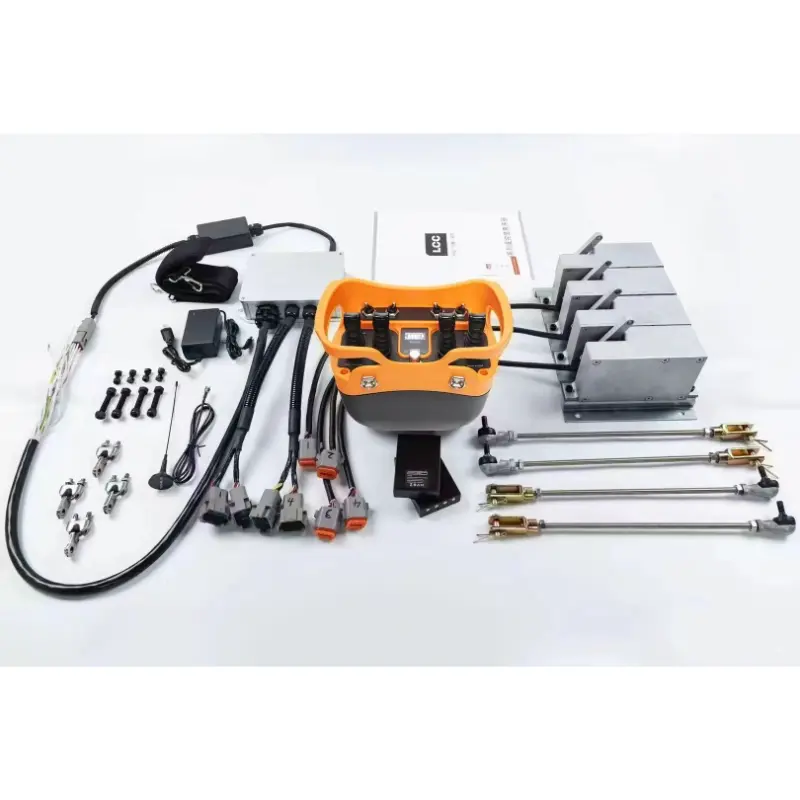
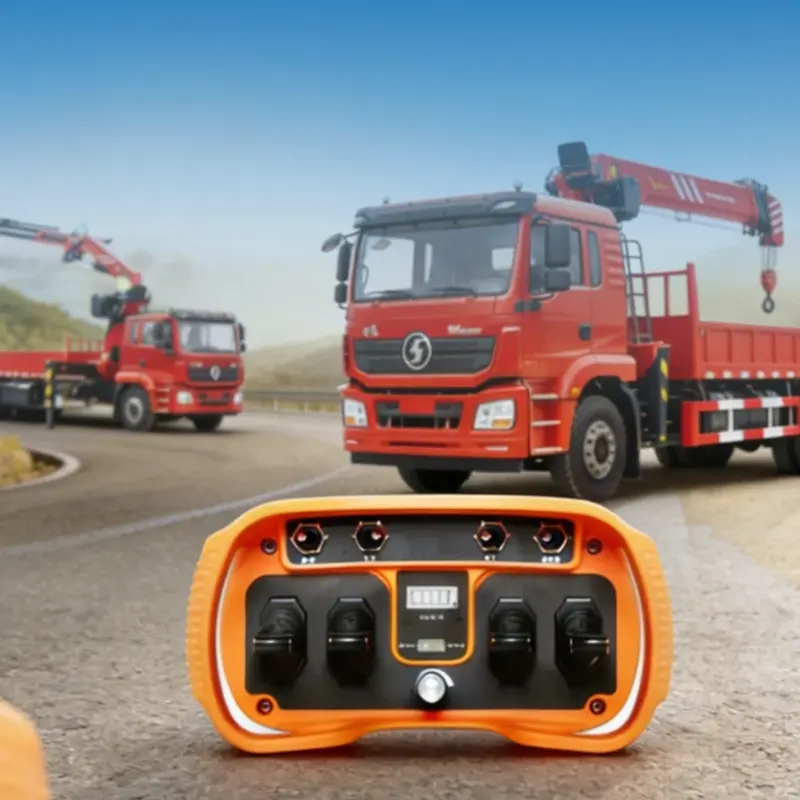
- Belly Box / Joystick Transmitters: Required for complex operations involving more than three motions, proportional control (stepless speed variation), or auxiliary functions like rotating grabs, magnets, or tandem lifts. These units strap to the operator’s waist, providing dual-joystick manipulation mimicking a traditional crane cabin.
Transmitter Comparison Matrix
| Feature/Specification | Push-Button Transmitters | Belly Box / Joystick Transmitters |
|---|---|---|
| Ideal Application | Standard overhead cranes, hoists, monorails | Tower cranes, mobile cranes, multi-hoist complex systems |
| Control Precision | 1-step or 2-step digital speed | Fully proportional, stepless analog control |
| Ergonomics | Lightweight, one-handed, high mobility | Requires harness, two-handed, heavier |
| Customization | Limited to button configurations | High (toggle switches, dials, customized joysticks) |
| Typical Cost | Lower initial investment | Higher capital expenditure |
3. Evaluating Safety Standards and Compliance
In B2B industrial equipment procurement, safety certifications are the baseline for qualification. The chosen system must adhere to international safety protocols to protect workers and shield the company from liability.
- Performance Level (PL) and Safety Integrity Level (SIL): The Emergency Stop (E-Stop) function is the most critical component. The system’s E-stop must meet at least EN ISO 13849-1 Performance Level d (PL-d) or IEC 61508 Safety Integrity Level 3 (SIL 3). This guarantees hardware redundancy; if one component fails, the crane will still safely halt.
- Tandem Operation Capabilities: For facilities requiring two cranes to lift a single oversized load, the remotes must support safe “pitch and catch” or tandem configurations. This ensures both cranes perfectly synchronize their movements and simultaneously halt if an E-stop is triggered on either transmitter.
4. Power Management and Battery Ecosystem
Downtime caused by a dead transmitter battery is unacceptable in a high-throughput production environment. Modern systems rely on advanced lithium-ion technology rather than outdated alkaline or NiMH batteries. Procurement should verify the continuous operating hours per charge (aiming for a minimum of 12-16 hours to cover standard shifts plus overtime). Furthermore, the availability of smart charging docks and hot-swappable batteries ensures that operators can seamlessly switch power sources without interrupting the workflow.
Conclusão
Procuring the correct communication interface for heavy lifting equipment demands a strategic alignment of facility environment, crane complexity, and operator ergonomics. By prioritizing robust interference management, appropriate ergonomic designs, and uncompromising safety standards, organizations can drastically improve their material handling efficiency while safeguarding their most valuable asset: their workforce.
Perguntas frequentes
Q1: Can a single remote control be programmed to operate multiple different cranes in our facility?
Yes. Advanced systems offer “Pitch and Catch” or multi-crane selection features. An operator can safely log into Crane A, complete a task, release control, and then log into Crane B using the same transmitter. However, strict digital handshakes and safety interlocks are required to prevent accidental operation of the wrong crane.
Q2: What is the typical lifespan of an industrial remote transmitter before it needs replacement?
With proper maintenance, a high-quality industrial transmitter typically lasts 5 to 7 years. The lifespan heavily depends on the harshness of the environment (chemical exposure, drops). Most reputable manufacturers offer modular designs where individual components (like a broken joystick or worn-out rubber push-button) can be replaced, extending the overall unit’s life to over 10 years.
Q3: How do we prevent unauthorized personnel from operating the crane via the remote?
Modern industrial remotes feature sophisticated access control mechanisms. Instead of physical keys, which are easily lost or copied, advanced units utilize RFID tags, magnetic iButtons, or programmable PIN codes. The transmitter remains deactivated and completely useless until an authorized operator scans their unique ID.